
Market & Portfolio Update
Q2 2026
Prepared by the Investment Management Committee – July 2026
This report is provided for information purposes only and does not constitute personal investment advice. The content reflects Welsh & Taylor Wealth’s views as at April 2026 and may change without notice.
Market Overview
Q2 2026 saw a significant improvement in market sentiment following the volatility experienced earlier in the year. Key developments included:
Oil prices falling as tensions in the Middle East eased and shipping through the Strait of Hormuz gradually returned to normal.
Inflation concerns reducing as energy prices stabilised.
Global equity markets recovering strongly from their Q1 weakness.
Investors focusing once again on company earnings, economic growth and interest rates.
While geopolitical risks remain, global markets have shown resilience and continue to be supported by a relatively stable economic backdrop.
The "Great Rotation" - A Broadening Bull Market
One of the most important themes of Q2 has been the broadening of market leadership.
For the past two years, returns have been heavily concentrated in a small number of large AI and technology companies. During Q2, however, investors began moving money into other sectors, including:
Healthcare
Financials
Industrials
Small-cap companies
This is known as the "Great Rotation". Importantly, this does not appear to be investors leaving the stock market. Instead, money is being reallocated to areas that had previously been overlooked.
Why this matters for our portfolios:
UK and European markets have greater exposure to financials, healthcare and industrials.
Returns are becoming less dependent on a handful of US technology stocks.
Broader market participation is typically a healthy sign during a long-term bull market.
Gold: Volatile but Valuable
Gold has had a mixed start to 2026.
Earlier in the year, rising oil prices increased inflation concerns and strengthened the US dollar. As gold is priced in dollars, this created a challenging environment for the precious metal.
More recently, gold has started to regain support due to:
Easing geopolitical tensions
Expectations that interest rates are nearing their peak
Continued central bank demand
Ongoing concerns around government debt and global uncertainty
While short-term price movements can be unpredictable, gold continues to play an important role in our portfolios by providing diversification and helping to reduce overall portfolio risk.
Central Banks: A More Balanced Outlook
At the start of 2026, markets expected several interest rate cuts.
Following the energy-driven inflation concerns in Q1, those expectations were pushed back. However, with oil prices falling and inflation continuing to moderate, central banks are now moving towards a more balanced position.
Our Current View:
Inflation should continue to drift lower.
Interest rates are likely to remain stable in the near term.
Future rate cuts are expected to be gradual.
Central banks will remain focused on incoming economic data.
What This Means for Investors:
A more stable interest-rate environment is generally supportive for both shares and bonds.
Economic growth remains positive despite slower activity.
Long-term investors continue to be rewarded for staying diversified and avoiding short-term market speculation.
Portfolio Insights
Our investment committee regularly reviews portfolio positioning to ensure alignment with market conditions, long-term strategy, and client outcomes.
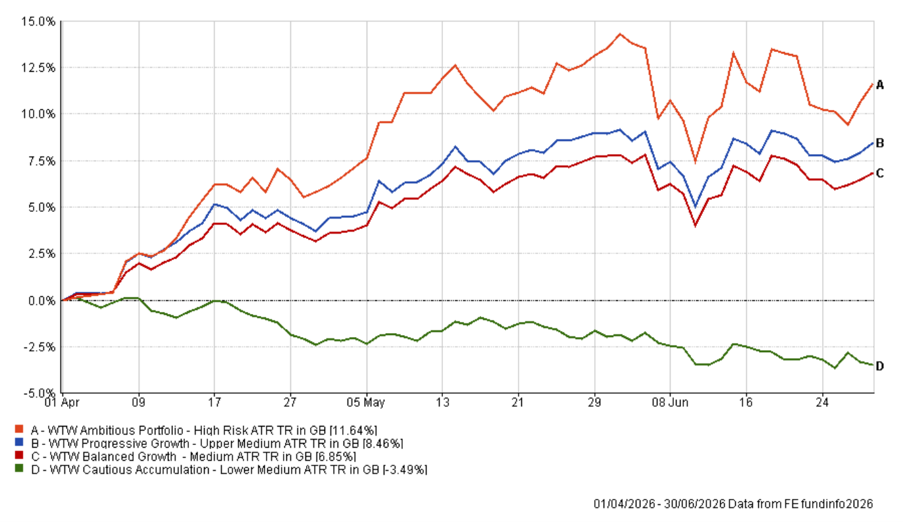
Portfolio Performance in Q2 2026 (1 April – 30 June)
WTW Ambitious Accumulation: +11.64%
WTW Progressive Growth: +8.46%
WTW Balanced Growth: +6.85%
WTW Cautious Accumulation: -3.49%
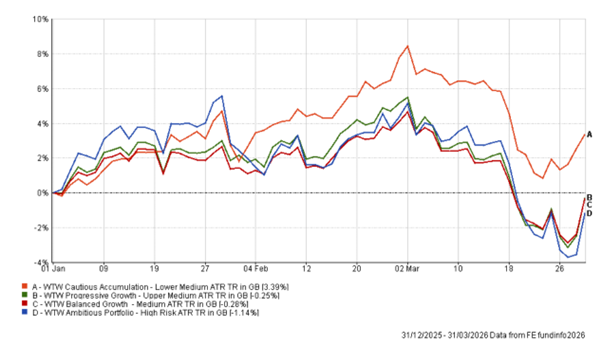
Q2 2026 Portfolio Performance (1 April 2026 – 30 June 2026)
Assessing Value and Client Outcomes
As part of our ongoing commitment to delivering good outcomes for clients, we regularly assess whether our portfolios continue to meet their stated objectives and represent fair value. This involves reviewing performance, cost efficiency, risk management, and suitability against client expectations and the broader market environment.
-
Risk Profile: Lower Medium
Q2 2026 Total Return: -3.49%
Sharpe Ratio: 0.85
Annual Fund Charge: 0.17%
Objective:
To achieve long-term growth while managing volatility through diversification across fixed interest, cash, commodities, and equities.Assessment:
The Cautious Portfolio has delivered +7.07% since launch (8 July to 30 June 2026). Despite a negative return this quarter, we consider the Cautious Accumulation Portfolio to be performing in line with the objective since inception.Key contributors to performance have included:
Stable returns from money market and short-term bond holdings.
Positive contributions from gold during periods of market uncertainly.
Ongoing charges remain competitive relative to the peer group, and the fund mix continues to prioritise liquidity and cost efficiency.
Why we remain comfortable:
Low volatility relative to equity markets.
Strong diversification across multiple asset classes.
High levels of liquidity and capital preservation.
Appropriate positioning for investors seeking growth with lower risk.
Overall, we believe the portfolio continues to provide fair value and remains well aligned with its objective of delivering steady long-term growth while managing downside risk.
-
Risk Profile: Medium
Q2 2026 Total Return: +6.85%
Sharpe Ratio: 1.64
Annual Fund Charge: 0.09%
Objective:
To provide long-term capital growth by investing across developed global markets. The portfolio balances growth opportunities with risk management, aiming to deliver strong returns over the medium to long term.Assessment:
Since launch to 30th June 2026, the Balanced Growth Portfolio has returned +18.66%, reflecting strong global equity performance alongside well-managed fixed income exposure.Performance has been supported by:
Strong global equity markets.
Broad diversification across developed economies.
Fixed interest holdings providing stability during periods of market volatility.
Why We Remain Comfortable
Well diversified across asset classes and regions.
Continued participation in global growth opportunities.
Bond allocation helping to reduce overall portfolio volatility.
Strong risk-adjusted returns since launch.
The portfolio continues to meet it’s objective of providing consistent long-term growth while maintaining a balanced approach to risk.
-
Risk Profile: Upper-Medium
Q2 2026 Total Return: +8.46%
Sharpe Ratio: 2.03
Annual Fund Charge: 0.07%
WTW Progressive Growth Portfolio
Objective:
To generate long-term capital growth through broad exposure to global equity markets while maintaining diversification across regions and sectors.Assessment:
The Progressive Growth Portfolio has achieved +23.51% since launch to 30th June 2026, driven by continued strength in global equity markets while also capturing gains from broader market participation during 2026.Key drivers have included:
Strong performance from US equities.
Exposure to developed international markets.
Increasing participation from UK and European markets and market leadership broadened beyond technology stocks.
Why We Remain Comfortable
Strong long-term growth potential.
Broad diversification across global markets.
Exposure to both established and emerging market themes.
Portfolio performance remains consistent with its long-term objectives.
The portfolio continues to deliver on its objective of achieving higher levels of growth for investors willing to accept greater market fluctuations.
-
Risk Profile: Upper Medium
Q2 2026 Total Return: +11.64%
Sharpe Ratio: 1.86
Annual Fund Charge: 0.20%
Objective:
To achieve high levels of long-term capital growth through a high-conviction portfolio focused on global growth equities, emerging markets, small companies and commodities.Assessment:
Since launch to 30th June 2026, the Ambitious Growth Portfolio has achieved +28.03%. The Ambitious Growth Portfolio remains our highest-risk, highest-growth strategy and has delivered the strongest return since launch.Performance has been driven by:
Significant exposure to global technology and innovation leaders.
Strong returns from the NASDAQ 100.
Positive contributions from gold.
Diversification through small-cap and emerging market investments, including China.
Why We Remain Comfortable
Exposure to long-term structural growth themes.
Diversification across global growth sectors and regions.
Strong participation in technology-driven market returns.
Performance remains well aligned with expectations for a high-growth portfolio.
While short-term volatility should be expected, we believe the portfolio remains well positioned for investors seeking maximum long-term capital growth.
How Do Our Portfolios Compare?
To assess performance objectively, we compare our portfolios against the Adviser Fund Index (AFI) - a recognised industry benchmark compiled by Financial Express from the recommended portfolios of leading UK financial advisers.
The AFI represents a realistic “market average” for professionally managed portfolios across three risk levels:
AFI Cautious - lower-risk portfolios with a higher allocation to bonds and cash.
AFI Balanced - medium-risk portfolios combining equities and fixed income for steady growth.
AFI Aggressive - higher-risk portfolios with greater exposure to global equities.
By comparing each WTW portfolio to its corresponding AFI benchmark, we can objectively determine whether our portfolios are providing clients with added value relative to the broader advice market.
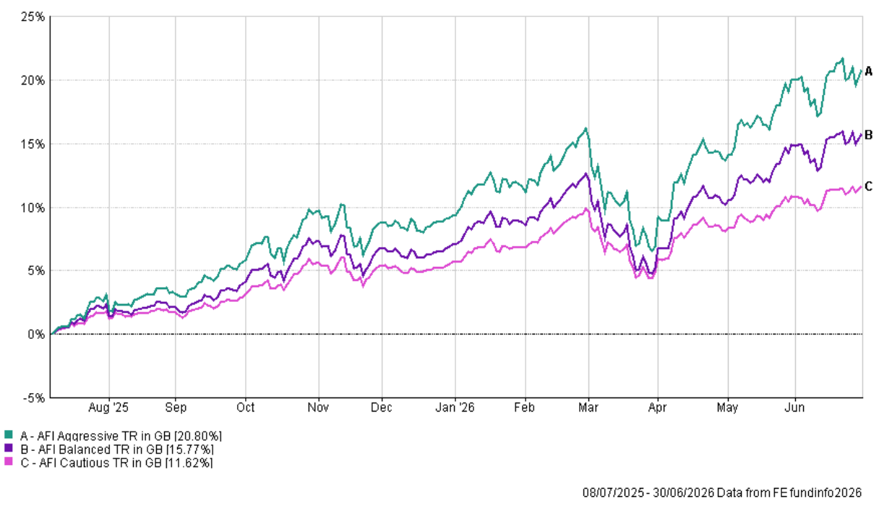
Performance Comparison (8 July 2025 - 30 June 2026)
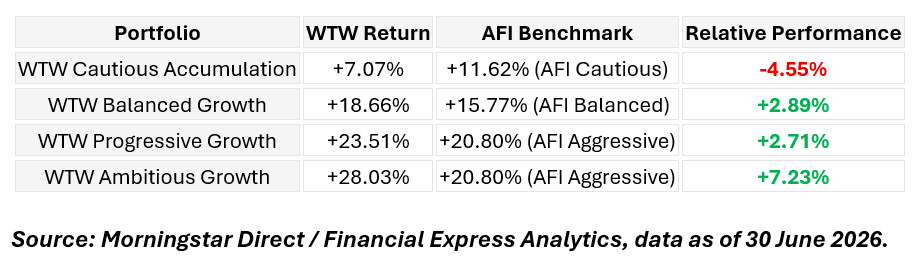
WTW Cautious Accumulation Portfolio - Relative Performance
While the WTW Cautious Accumulation Portfolio has delivered a positive return of +7.07% since launch, it has lagged the AFI Cautious Benchmark, which returned +11.62% over the same period.
The primary reason for this difference has been the portfolio's strategic allocation to physical gold. Following a period of exceptional performance during 2025 and early 2026, gold experienced one of its most challenging quarters in recent years as easing geopolitical tensions, a stronger US dollar and improving investor confidence reduced demand for traditional safe-haven assets.
Importantly, this short-term weakness does not alter our long-term view. Gold remains an important component of the portfolio because it provides diversification benefits that many traditional asset classes cannot. During periods of market stress, inflation shocks or geopolitical uncertainty, gold has historically helped reduce portfolio volatility and preserve capital.
We believe it is important to assess the Cautious Portfolio against its stated objective rather than focusing solely on short-term benchmark comparisons. The portfolio is designed to prioritise capital preservation, lower volatility and diversified returns rather than maximise equity market participation.
Why We Remain Positive
The portfolio continues to deliver positive returns with significantly lower risk than equity-focused strategies.
Gold remains supported by long-term structural factors, including ongoing central bank purchases, elevated global debt levels and continued geopolitical uncertainty.
Bond and money market allocations continue to provide stability and attractive income relative to recent years.
The portfolio remains well positioned should market volatility re-emerge or economic growth slow.
Why We Are Not Making Any Changes at This Time
As we move into the second half of 2026, our core message remains unchanged: successful investing is built on discipline, not prediction.
The first half of the year provided a powerful reminder of this principle. During the peak of the Iran conflict and the disruption to shipping through the Strait of Hormuz, markets experienced significant volatility, oil prices surged, and investor sentiment deteriorated rapidly. Faced with considerable uncertainty, we chose not to make reactive portfolio changes or attempt to trade short-term headlines.
Instead, we remained focused on our long-term investment process and the strategic positioning of our portfolios.
Looking back, we believe this was the correct decision.
As tensions eased, shipping routes gradually reopened, oil prices retreated, and investor confidence improved. Investors who remained patient and disciplined were ultimately rewarded, while those attempting to predict every market move faced the difficult challenge of making multiple correct decisions in a rapidly changing environment.
Our portfolios are designed to navigate uncertainty through diversification rather than prediction.
We continue to believe that:
Long-term investment success comes from remaining invested.
Market timing is extremely difficult, even for professional investors.
Diversification remains one of the most effective tools for managing risk.
Short-term geopolitical events rarely justify long-term strategic portfolio changes.
The events of the last quarter have reinforced our belief in this approach.
The resilience shown by markets during Q2 reinforces the value of this approach.
Why Our Current Positioning Continues to Make Sense
Importantly, our current market outlook remains closely aligned with the way our portfolios are positioned.
As discussed earlier in this report, we are seeing signs of a broadening bull market, with leadership expanding beyond a small number of large US technology companies into sectors such as healthcare, financials, industrials, and selected international markets.
This is encouraging because our portfolios already have meaningful exposure to many of the areas now attracting investor interest, including:
Global developed market equities
UK and European equities
Financials, healthcare and industrial companies
Gold and other diversifying assets where appropriate
Broad regional and sector diversification
Rather than relying on a single investment theme, our portfolios are designed to participate in long-term growth wherever it emerges.
The events of the last quarter have strengthened our conviction in this approach. A market supported by a wider range of sectors and regions is typically healthier and more sustainable than one driven by only a handful of companies. Encouragingly, this broadening trend aligns well with our existing holdings, which is one of the reasons we have maintained our positions rather than making reactive changes.
Looking Ahead
While challenges remain, including geopolitical uncertainty, inflation risks, and the future path of interest rates, we remain constructive on the longer-term outlook.
We are encouraged by:
Improving market breadth and the ongoing "Great Rotation".
Stabilising energy markets following the easing of Middle East tensions.
A more balanced outlook from central banks.
Continued strength in corporate earnings and global economic activity.
Most importantly, we remain confident that our portfolios are appropriately positioned to meet their long-term objectives.
Key Takeaways
When uncertainty is high, doing nothing can often be the most difficult decision - but also the most effective.
The events of 2026 have reinforced a lesson that successful investors have learned time and again: Markets reward patience far more often than they reward prediction.
By remaining invested, diversified, and focused on long-term outcomes, we believe investors give themselves the best opportunity to achieve their financial goals.
Our focus remains unchanged: Stay diversified. Stay disciplined. Stay invested for the long term.
This report is provided for information purposes only and does not constitute personal investment advice. The content reflects Welsh & Taylor Wealth’s views as at July 2026 and may change without notice.
Past performance is not a reliable indicator of future results. The value of investments and the income from them can fall as well as rise, and you may not get back the amount originally invested.
All investments carry risk. The portfolios described in this document are subject to market risk, currency risk, and, in some cases, liquidity and credit risk. Diversification does not guarantee a profit or protect against loss in a declining market.
Tax treatment depends on individual circumstances and may change in future. If you are unsure about the suitability of any investment, you should seek personal advice.
Welsh & Taylor Wealth is a trading name of WTW Ltd, which is authorised and regulated by the Financial Conduct Authority (FCA).